
About us
Vihara and monastic tradition
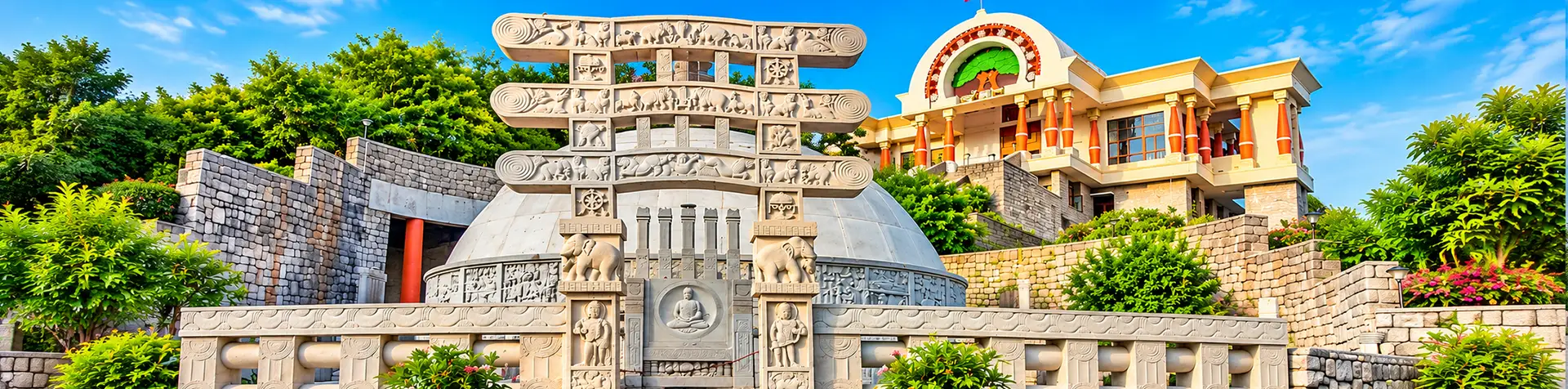
Sacred architecture drawn from Amaravati and Karle, and a community of monks living by a rule that goes back to the Buddha.
The main shrine hall
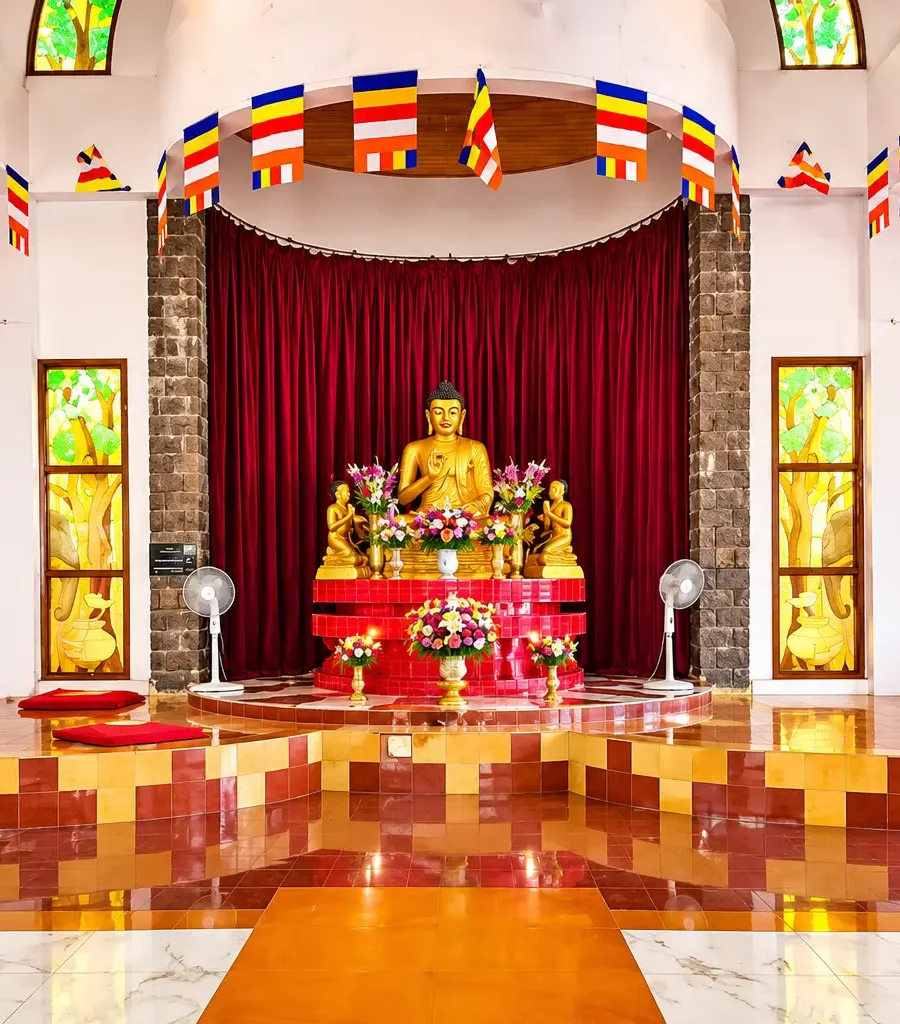
The main shrine hall is a vaulted chaitya hall, its arched façade modelled on the great rock-cut shrine at Karle in Maharashtra. Above the door an aniconic image recalls the earliest Buddhist art, in which the Buddha was shown by symbols rather than in human form.
Inside, a golden image of the Buddha sits in meditation, flanked by his two chief disciples, Sāriputta and Moggallāna. Stained-glass windows tell Jātaka stories of the Buddha’s former lives, among them the Sasa, Sibi, Mahāpaduma and Dīghitikosala Jātakas.
The five āyaka pillars
Five pillars stand on the āyaka platform before the stūpa, as at Amaravati.
- 1
Birth
Prince Siddhattha is born in the Lumbinī grove.
- 2
Renunciation
He leaves the palace to seek an end to suffering.
- 3
Awakening
Under the Bodhi tree at Bodh Gayā, he becomes the Buddha.
- 4
First teaching
At Sārnāth he sets the wheel of Dhamma in motion.
- 5
Parinibbāna
His final passing at Kusinārā, and the sharing of the relics.
The Bodhi tree
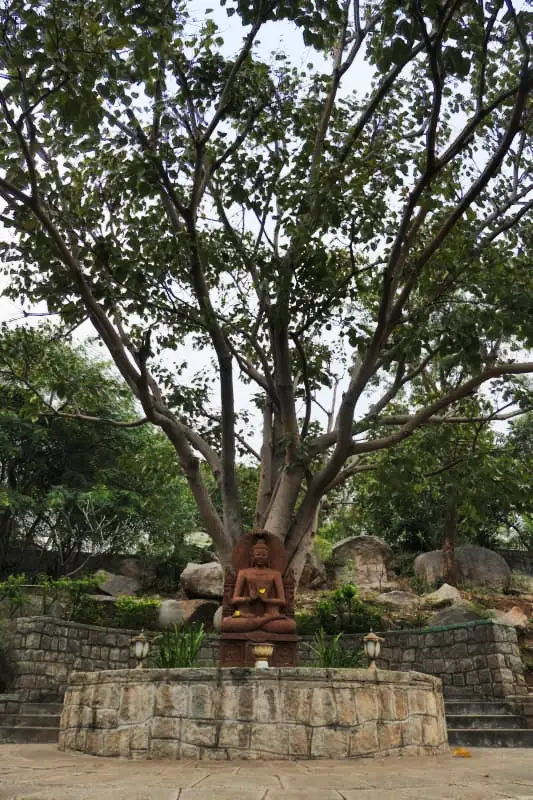
The Bodhi tree at the Vihara grew from a sapling brought by monks from Sri Lanka at the inauguration in 2003. It descends from the Sri Mahā Bodhi at Anurādhapura, which was itself grown from a branch of the tree at Bodh Gayā, carried to Sri Lanka in the time of Emperor Asoka.
The tree stands on a raised platform inside a small amphitheatre. In the evenings the monks sit and study beneath it, and the Sunday guided meditation is held here.

A day in the monastery
The monks follow the Vinaya, the code of discipline laid down by the Buddha. They rise before dawn for chanting and meditation, take their meals before noon, and spend the day in study, teaching and the work of the monastery.
The resident community includes novices (sāmaṇeras) from many parts of India, who study the Buddha’s teaching alongside Pāli, English, computers and mathematics.
| When | Program | Where |
|---|---|---|
| Dawn 4:30 am | Rising, meditationPersonal practice in the shrine hall | Shrine hall |
| Morning 6:00 am | Buddha pūjā and chantingOpen to visitors | Shrine hall |
| Forenoon 8:00 am | Classes and studyDhamma, Pāli and school subjects | Study hall |
| Midday 11:00 am | Last meal of the dayOffered by lay supporters (dāna) | Dāna hall |
| Evening 6:30 pm | Chanting and meditationOpen to visitors | Shrine hall |
Visiting with respect
A few simple customs help everyone feel at ease.
- Remove footwearBefore entering the shrine hall and the stūpa terrace.
- Dress modestlyShoulders and knees covered, please.
- Keep a quiet voiceEspecially during chanting and meditation.
- Greet monks with añjaliPalms joined; please do not offer a handshake.
- Ask before photographingMonks and ceremonies, in particular.
- Walk clockwiseKeep the stūpa and Bodhi tree on your right.